
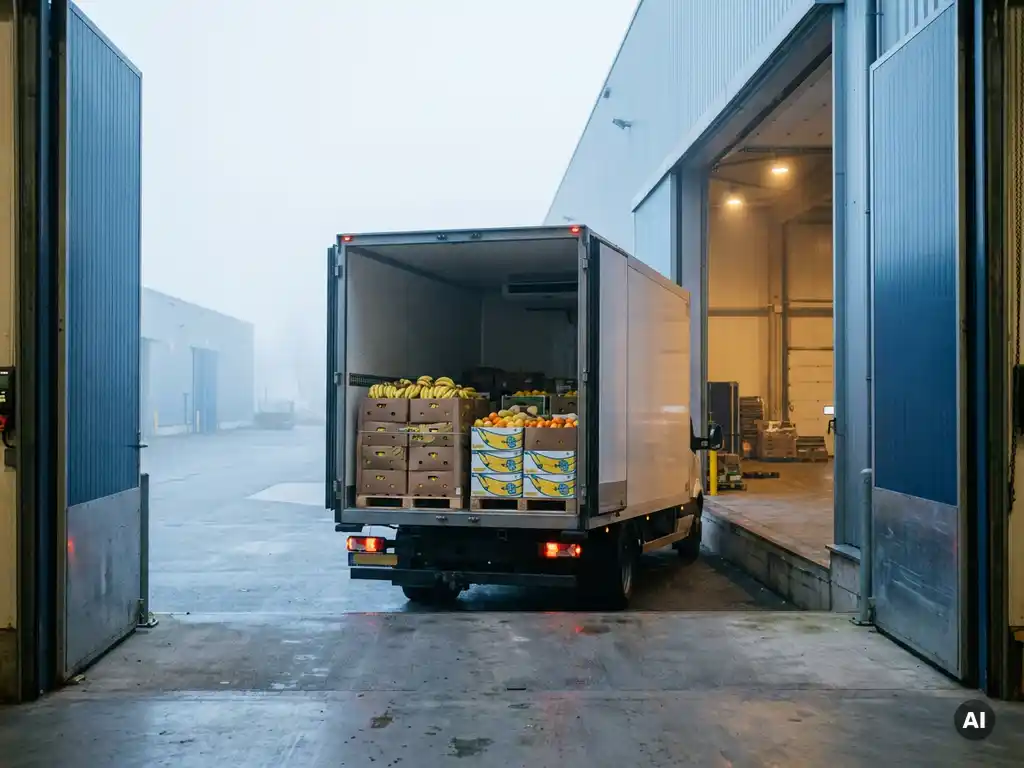
A logistics partner ensures continuous delivery to your factory by managing the entire supply chain: from the moment goods enter the port until the moment they arrive on the production floor. For factories working with temperature-sensitive products such as exotic fruit, this is not a minor detail but an operational necessity. The sections below answer the most frequently asked questions on this subject.
What are the risks of a disrupted supply chain for factories?
An interrupted supply chain leads directly to production downtime, loss of quality, and financial damage. For factories working with fresh, perishable raw materials, a supply chain interruption is particularly costly: not only is the raw material lost, but planned production capacity is also lost while fixed costs continue to accrue.
The risks are concrete and multifaceted. Consider:
- Loss of quality due to temperature fluctuations during transport or handling, causing products to no longer meet production standards.
- Production stoppage when raw materials arrive late or in insufficient quantities
- Contractual obligations towards customers that cannot be fulfilled
- Unexpected emergency costs for alternative supply or extra transport
- Reputational damage with regular customers if delivery agreements are systematically not met
For factories that process exotic fruit, the margin for error is particularly small. Products such as bananas and citrus fruits ripen quickly and react strongly to temperature fluctuations. A gap of even a few hours in the cold chain can render an entire batch unusable for processing.
How does a logistics partner manage the cold chain from start to finish?
A logistics partner manages the cold chain by monitoring and ensuring temperature and humidity conditions at every transfer point. This begins with the unloading of the ship, continues during storage, and ends with delivery to the factory. The goal is to ensure that the cold chain is never interrupted.
Effective cold chain management involves multiple links. Upon arrival at the port, products are transferred to refrigerated storage areas as quickly as possible to minimize exposure to ambient temperature. During the storage phase, temperature, humidity, and air circulation are continuously monitored and adjusted. When loading at the factory, refrigerated transport ensures the chain remains intact.
A well-equipped logistics partner has systems that are active 24 hours a day, 7 days a week. This means that deviations are detected and corrected even outside office hours. For factories that depend on a constant flow of high-quality raw materials, this level of monitoring is not a luxury but a basic requirement.
Which storage facilities are essential for reliable delivery?
For a reliable supply to a factory, at least two types of storage facilities are necessary: temperature-controlled cold rooms for fresh products and dry storage warehouses for non-refrigerated raw materials. The combination of both makes it possible to properly manage a wide range of raw materials.
Cold storage rooms must be flexibly adjustable so that the climate can be tailored per product category. Bananas require different conditions than citrus fruits, and a good logistics partner can adjust those settings per batch. Dry storage warehouses are suitable for products such as nuts, peanuts, and seeds, which do not require refrigeration but must be protected against moisture and temperature fluctuations.
In addition, the location of the storage facility relative to the port is of great importance. The shorter the distance between unloading and storage, the lower the risk of quality loss during transshipment. A private quay directly adjacent to the cold storage facility eliminates virtually all exposure to external conditions. For dry storage, sufficient capacity and separate areas for each product type are essential to prevent cross-contamination and quality loss. More information on dry storage solutions helps in assessing the appropriate facilities for non-refrigerated raw materials.
How does a logistics partner adapt to changing ship schedules?
A logistics partner adapts to changing ship schedules by building in operational flexibility: keeping sufficient personnel and resources available for unexpected arrival times, and planning storage capacity to absorb fluctuations in supply without loss of quality.
In practice, ship schedules are rarely exact. Weather conditions, port congestion, and changes in shipping routes mean that arrival times regularly deviate from the plan. A logistics partner prepared for this works with systems that process real-time information regarding the expected arrival of ships and adjust unloading capacity accordingly.
For factories, this is crucial: the production line does not wait for a delayed ship. A good logistics partner acts as a buffer. By storing products in a timely manner and delivering them in a staggered manner, the factory is decoupled from the vagaries of the sailing schedule. This requires not only technical infrastructure but also a flexible organization capable of operating outside regular working hours.
What is the difference between cold storage and dry storage for factory supply?
Cold storage is temperature-controlled storage for fresh, perishable products that require a specific climate, whereas dry storage is intended for non-perishable products that can be stored at ambient temperature. For factory supply, the nature of the raw material determines which type of storage is necessary.
Cold storage: for fresh and perishable products
Cold storage is used for products where temperature and humidity directly affect shelf life and quality. Exotic fruits such as bananas and citrus fruits fall into this category. Storage conditions are precisely set per product type and continuously monitored. Deviations are corrected immediately to prevent loss of quality. For factories that process these products, cold storage is not an option but a requirement.
Dry storage: for stable raw materials
Dry storage, also known as ambient storage, is suitable for products that do not require refrigeration but must be protected against moisture, heat, and cross-contamination. Nuts, peanuts, and seeds are examples of products stored in a dry warehouse. A well-designed dry warehouse uses separate areas for each product category to ensure the integrity of each product. For factories that process multiple types of raw materials, access to both storage methods from a single logistics partner is a logistical advantage.
When does a factory need a dedicated logistics partner?
A factory needs a dedicated logistics partner when the supply of raw materials is too complex, too sensitive, or too critical to manage internally. This is the case for factories that work with perishable products, rely on international shipping, or where an interruption in the supply directly leads to production downtime.
Concrete signs that it is time for a dedicated partner include:
- Growing volumes that exceed own logistics capacity
- Recurring quality problems upon arrival of raw materials, caused by a defective cold chain
- Increasing complexity due to multiple suppliers, ports, or product categories
- Need for certification such as BRC or SKAL, which set specific storage requirements
- Insufficient buffer capacity to absorb fluctuations in ship schedules
A dedicated logistics partner not only takes over operational execution but also brings expertise in customs clearance, import inspections, and sector-specific regulations. For factories processing exotic fruit, this means that inspections by the NVWA and the associated documentation are also handled professionally. This relieves the purchasing organization and reduces the risk of delays due to administrative errors.
How ZZColdstores helps with continuous factory supply
ZZColdstores supports processing plants as a dedicated logistics partner for the temperature-controlled storage and supply of exotic fruit and dry raw materials. From locations in Kruiningen and Vlissingen, with its own quay directly next to the cold storage facility, ZZColdstores manages the entire chain from unloading to delivery.
What ZZColdstores specifically offers for factory supply:
- Climate-controlled cold rooms with adjustable temperature and humidity per product category
- Dry storage warehouse with 12,000 pallet spaces and separate areas for nuts, peanuts, and seeds
- Private quay in Vlissingen for minimal exposure during transfer from ship to cold storage.
- Flexible operation tailored to changing ship schedules
- Import inspection and customs clearance as part of the service package
- certifications for factories with specific quality requirements
Would you like to know if ZZColdstores is the right partner for your factory supply? Contact us via the website for a no-obligation discussion about the possibilities.
This article was written by Frans van der Maas, Operations Director at ZZColdstores.
Frequently Asked Questions
What is the maximum length of time that perishable raw materials such as exotic fruit can be stored in cold storage without loss of quality?
The maximum shelf life varies per product and depends on the set temperature, humidity, and ripening stage upon arrival. Under the right conditions, bananas can generally be stored for one to three weeks, while citrus fruits often have a longer shelf life. A good logistics partner sets the storage conditions individually for each batch and actively monitors the quality, ensuring that products are delivered to the factory at the right time.
What happens if a malfunction occurs in the refrigeration system during storage?
A reliable logistics partner works with redundant systems and alarm protocols that are active 24/7, ensuring that malfunctions are detected immediately—even outside office hours. In the event of a calamity, emergency procedures are activated immediately: think of switching to backup cooling or urgent transport to an alternative storage location. When selecting a logistics partner, it is advisable to explicitly ask about their disaster plan and how they inform factory customers about it.
Which certifications must a logistics partner have for the storage of organic fruit or certified raw materials?
For the storage of organic products, SKAL certification is required, which guarantees that organic and conventional products are stored and processed strictly separately. Factories working with Demeter-certified raw materials need a partner with additional Demeter certification. Furthermore, BRC (British Retail Consortium) certification is an important quality standard demonstrating that the storage facility meets international food safety requirements — essential for factories supplying retail chains or export markets.
How does customs clearance and NVWA inspection work for the import of exotic fruit, and what does a factory need to arrange itself?
When importing exotic fruit from non-EU countries, a phytosanitary inspection by the NVWA (Netherlands Food and Consumer Product Safety Authority) is mandatory, in addition to the usual customs formalities. A dedicated logistics partner typically takes over these processes completely: from supplying the necessary import documents to supervising the physical inspection at the unloading dock. For the factory, this means that the purchasing organization is relieved of complex regulations, provided the logistics partner has demonstrable experience with these procedures.
As a factory, how do I make a good comparison between logistics partners for my specific supply needs?
Start by drawing up a list of hard requirements: which products do you want to store, which certifications are mandatory, how frequently and in what volumes deliveries are made, and via which port do the raw materials arrive? Next, assess each candidate partner on-site against the port, available storage capacity, flexibility outside office hours, and demonstrable experience with similar factory clients. Always ask for references and visit the facilities in person to assess the condition of the cooling infrastructure and the working methods on the factory floor.
Can a logistics partner also step in during sudden peaks in supply, for example during a large seasonal harvest?
Yes, but this requires the logistics partner to have scalable storage capacity and flexible staffing. Always discuss seasonal peaks with your partner in advance so that storage and unloading capacity are reserved in a timely manner. Partners with multiple locations or expandable warehouse capacity offer more certainty in this regard than parties operating on fixed occupancy and capacity.
What are the most common mistakes factories make when choosing or managing a logistics partner?
A common mistake is selecting a partner based solely on price, without paying sufficient attention to certifications, location, and 24/7 availability. Additionally, factories frequently underestimate the importance of clear communication agreements: who informs whom in the event of delays, quality deviations, or emergencies, and within what timeframe? Finally, the transfer of documentation—such as inspection reports, temperature logs, and customs papers—is often arranged only after the fact, whereas this should be established during contract negotiations to prevent delays and liability issues.
Related articles
- Why is humidity just as important as temperature in dry storage?
- Why do Ukrainian buyers choose storage via Dutch ports?
- How do you manage irregular shipping from Asia or Brazil?
- How does the supply of garlic from China via European ports work?
- How do you switch from on-premises storage to outsourced ambient storage?