
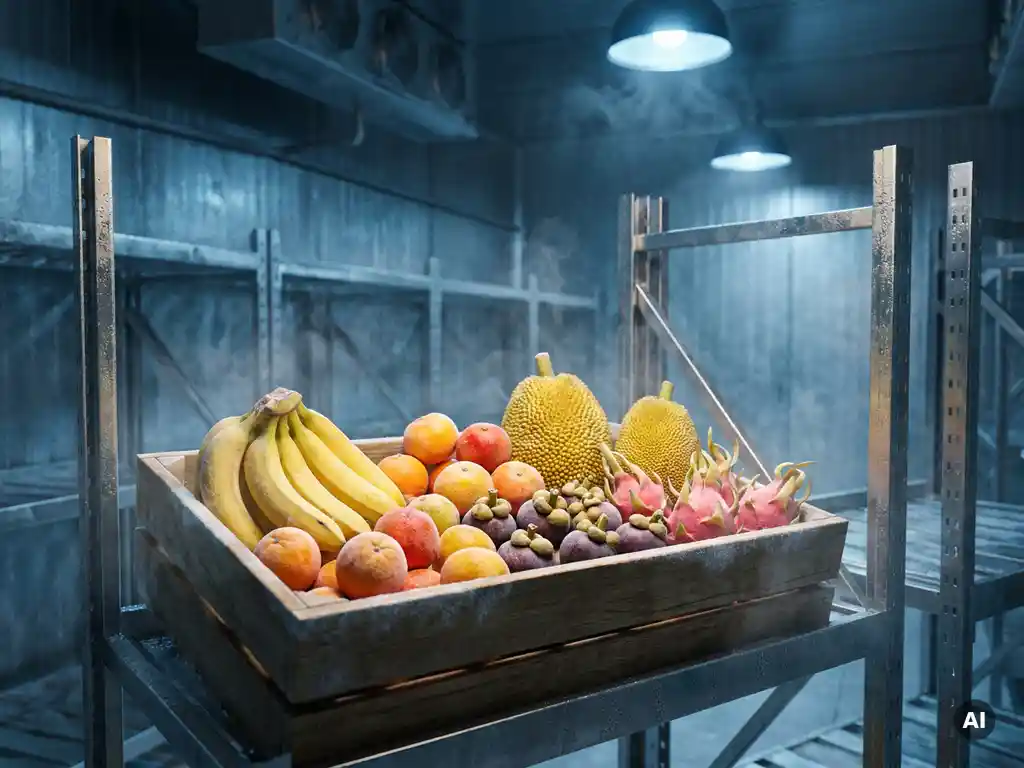
Foods that spoil due to temperature fluctuations require cold storage. This applies to fresh vegetables and fruit, dairy products, juices, and a wide range of other fresh products that deteriorate rapidly in quality at room temperature. In this article, we answer the most frequently asked questions about cold food storage, from the correct temperatures to the relevant certifications for professional storage.
What temperature is required for the cold storage of food?
The required temperature for cold storage of food varies by product type, but most fresh products are stored between 2°C and 15°C. Exotic fruits such as bananas generally require a higher minimum temperature than leafy vegetables or citrus fruits, because temperatures that are too low cause cold damage and irreversibly damage product quality.
No universal setting is applied within professional cold storage. Instead, climate chambers are tailored to the specific requirements of the goods for each product type. Three variables play a central role in this:
- Temperature: the core value that slows down spoilage and extends shelf life
- Humidity: too low and products dry out, too high and mold formation occurs
- Air circulation: ensures an even temperature distribution in the storage area
For dry, cool storage, such as for nuts, peanuts, and certain agricultural products, the ideal storage temperature is around 11°C. This is colder than an uncooled warehouse but warmer than a standard cold room for fresh fruit. The correct setting is always product-dependent and must be determined based on the specific characteristics of the goods.
Which fresh products require refrigerated storage?
Fresh products requiring refrigerated storage are all products where temperature directly affects shelf life and food safety. In a B2B logistics context, this primarily concerns exotic fruit, citrus fruits, tropical vegetables, juices, and other fresh agricultural products that continue to actively respire after harvest and therefore spoil quickly at excessively high temperatures.
Sensitivity to temperature fluctuations is a determining factor. Products exposed to temperature changes during transport or storage lose quality rapidly, which directly affects shelf life for the end customer. For suppliers to supermarket chains or processing plants, this is a critical point: a product leaving the cold chain rarely returns with the same quality.
Specifically, these are the most common categories of fresh products that require cold storage:
- Exotic fruits (bananas, mangoes, avocados, pineapple)
- Citrus fruits (oranges, grapefruits, lemons)
- Tropical vegetables
- Fresh juices and juice concentrates
- Seeds and kernels with a high moisture content
Do exotic fruits and citrus fruits have special storage requirements?
Yes, exotic fruits and citrus fruits have specific storage requirements that differ from standard refrigerated products. Bananas are cold-sensitive and must not be stored below a certain minimum temperature, whereas citrus fruits thrive at lower temperatures but are sensitive to excessive humidity. Both product groups require precise climate control throughout the entire storage period.
An additional complexity with exotic fruit is the ripening phase. Bananas are typically imported green and ripen during or after storage. The rate of this ripening process is directly controlled by temperature and ethylene concentration in the storage area. An environment that is too warm accelerates ripening uncontrollably, while an environment that is too cold completely blocks the ripening process and causes cold damage.
For citrus fruits, the peel is susceptible to moisture loss and mold formation. The right balance between temperature and humidity largely determines how long the product retains its market value. This makes climate-controlled storage for these product groups not a luxury, but a logistical necessity.
What is the difference between cold storage and dry storage for food?
The main difference between cold storage and dry storage for food is the storage temperature and humidity level in the storage area. Cold storage is used for fresh, perishable products that require active cooling to prevent spoilage. Dry storage, also known as ambient or dry cool storage, is intended for products that remain stable at a moderate temperature without active cooling, down to below 10°C.
Cold storage: for fresh and perishable products
Cold storage requires active climate control in which temperature, humidity, and air circulation are continuously monitored. The storage temperature typically ranges between 2°C and 15°C, depending on the product. This type of storage is indispensable for exotic fruits, citrus fruits, and other fresh agricultural products that spoil quickly at higher temperatures.
Dry, cool storage: for stable products
Dry storage at a controlled temperature, such as around 11°C, is suitable for products that do not require active cooling but benefit from a stable, cool environment. Examples include nuts, peanuts, seeds, and certain food raw materials. These products are less sensitive to temperature fluctuations but do benefit from a controlled environment that prevents oxidation, mold formation, and loss of quality.
Which food products can be stored in dry, cool storage?
Food products suitable for dry cool storage are products with a low moisture content and a stable chemical composition that do not require active refrigeration. Nuts, peanuts, seeds, and similar dry food raw materials are the most common categories that benefit from storage at a controlled temperature of around 11°C.
Dry cool storage offers benefits for products where oxidation and moisture absorption pose the greatest risks. A stable, cool environment slows down these processes without the need for the energy and cost intensity of a full-fledged cold room. For importers and wholesalers who trade large volumes of dry food products, this is an efficient storage option.
Examples of products that can be stored in dry, cool storage:
- Nuts (walnuts, almonds, cashews)
- Peanuts and peanut products
- Seeds (sunflower seeds, pumpkin seeds, flaxseed)
- Dried food raw materials
- Potato flakes and similar processed agricultural products
How long can food be stored in cold storage?
The maximum shelf life of food products in cold storage varies greatly by product and is determined by the combination of storage temperature, humidity, and the initial product quality upon arrival. Exotic fruits such as bananas generally have a shorter shelf life than citrus fruits, while dry products such as nuts remain edible for several months under the right conditions.
A critical factor that is often underestimated is product quality at the time of receipt. Products that are already partially damaged or that have been exposed to temperature fluctuations during transport have a significantly shorter shelf life, regardless of how good the storage conditions are. This is why quality control upon arrival is an integral part of professional cold storage.
Global guidelines for storage duration in cold storage:
- Bananas (green, pre-ripening): usually a few weeks at the right temperature
- Citrus fruits: several weeks to a few months depending on variety and origin
- Nuts and seeds (dry, cool storage): several months under stable conditions
It is important to emphasize that these guidelines depend heavily on the specific product characteristics and the precision of the climate control. Exact storage times are always determined in consultation based on the product specifications of the goods.
Which certifications are important for the cold storage of foodstuffs?
The most relevant certifications for professional cold storage of foodstuffs are BRC (British Retail Consortium), SKAL, and inspections by KCB (part of the NVWA). These certifications provide clients with assurance regarding food safety, traceability, and compliance with statutory import requirements, and are often a requirement for suppliers to supermarket chains and processing plants.
BRC is an internationally recognized standard for food safety that is required by many major supermarket chains and purchasing organizations as a minimum requirement for their suppliers. A certified storage partner with BRC certification demonstrably offers that processes, hygiene, and quality control meet strict international standards.
SKAL certification is relevant for organic products. Importers and wholesalers trading organically certified products are required to store their goods with a SKAL-certified party to maintain organic status. Demeter certification applies specifically to biodynamic products and imposes similar requirements on the supply chain.
The KCB inspection, carried out under the responsibility of the NVWA, is mandatory for the import of fresh fruit and vegetables from countries outside the European Union. A storage partner that can facilitate this on-site import inspection significantly accelerates the logistical process and prevents unnecessary delays in the cold chain.
How ZZColdstores helps with cold storage of food
ZZColdstores offers climate-controlled cold storage specifically designed for fresh and perishable products, with locations in Kruiningen and Vlissingen. The facilities are certified with BRC, SKAL, and Demeter, and offer the capability to facilitate on-site KCB import inspections. This makes ZZColdstores a full-fledged logistics partner for importers, wholesalers, and suppliers working with fresh agricultural products.
What sets ZZColdstores apart for B2B partners:
- Climate chambers adjustable per product for temperature, humidity, and air circulation
- 24/7 monitoring and control of storage conditions
- Own quay in Vlissingen for direct transshipment from the ship to cooling
- Dry storage warehouse with 12,000 pallet spaces for nuts, seeds, and similar products
- Full traceability via barcode system per pallet
- Quality control upon arrival, including temperature and humidity measurements
Do you have questions about storage options for your specific products, or would you like to know which conditions best suit your goods? View ZZColdstores' climate-controlled storage services or contact us directly to discuss the possibilities.
Frequently Asked Questions
How do I choose the right storage partner for my fresh products?
When choosing a cold storage partner, pay attention to three key points: the availability of the right certifications (such as BRC, SKAL, or Demeter), the ability to configure climate chambers per product type, and the proximity to your supply routes. Furthermore, a partner who can facilitate on-site import inspections, such as the KCB inspection, saves valuable time in the cold chain and reduces the risk of quality loss during unloading and storage.
What happens if the cold chain is temporarily interrupted during transport or transshipment?
An interruption of the cold chain, even if brief, can cause irreversible damage to temperature-sensitive products. Exotic fruits such as bananas and mangoes, in particular, react quickly to temperature fluctuations: ripening accelerates uncontrollably or cold damage occurs. It is therefore essential to work with a storage partner that has direct transshipment facilities, such as its own quay, so that the transition from transport to cooling is as short and controlled as possible.
Can I store different product types with different temperature requirements with the same storage partner?
Yes, provided the storage partner has multiple climate chambers that can be independently adjusted for temperature, humidity, and air circulation. This allows bananas and citrus fruits, which each have their own optimal storage conditions, to be stored simultaneously but separately. Always explicitly ask your storage partner about the flexibility of the climate control systems and whether the chambers are controlled individually or by zone.
How is product quality monitored during the storage period?
Professional cold storage involves more than just setting the right temperature. Quality control begins upon arrival with an inspection during which the temperature, humidity, and visual condition of the goods are recorded. Throughout the storage period, continuous monitoring and 24/7 alerting ensure that deviations are immediately detected and corrected. Furthermore, traceability per pallet via a barcode system makes it possible to quickly determine the conditions under which a specific batch was stored in the event of any quality complaints.
Is cold storage also suitable for smaller batches, or is it only worthwhile for large volumes?
Cold storage is relevant for both large and small volumes, as long as the products are temperature-sensitive and the cold chain must be maintained. For smaller importers or traders, it may be more cost-effective to work with an external storage partner than to invest in their own cooling infrastructure. Discuss with your storage partner which storage capacity and contract type best suits your volumes and the frequency of your deliveries.
What are the most common mistakes when storing fresh fruit and vegetables?
The most common mistakes are storing cold-sensitive products at temperatures that are too low (particularly exotic fruit), neglecting humidity control causing products to dry out or mold, and mixing products that influence each other's ripening via ethylene emissions. Bananas and apples, for example, emit relatively high levels of ethylene and can cause neighboring products to ripen faster. A good storage partner proactively advises on the correct product arrangement and climate settings to prevent this.
What documentation or information do I need to provide when storing products in cold storage?
When storing products in professional cold storage, it is generally required to provide product specifications, including the desired storage temperature, humidity level, and any special storage requirements. For imported products from outside the EU, import documents and phytosanitary certificates are also required for the KCB inspection. For organic or biodynamic products, additional requirements apply based on SKAL or Demeter certification. Coordinate this with your storage partner in advance to avoid delays upon arrival.
Related articles
- How can warehousing limit delays in the supply chain?
- What are the risks of improper storage of peanuts and cashews?
- What is the difference between a bonded warehouse and a regular warehouse?
- What is bulking and how does it work with powdered potatoes or big bags?
- How are big bags unloaded and redistributed onto pallets in a warehouse?