
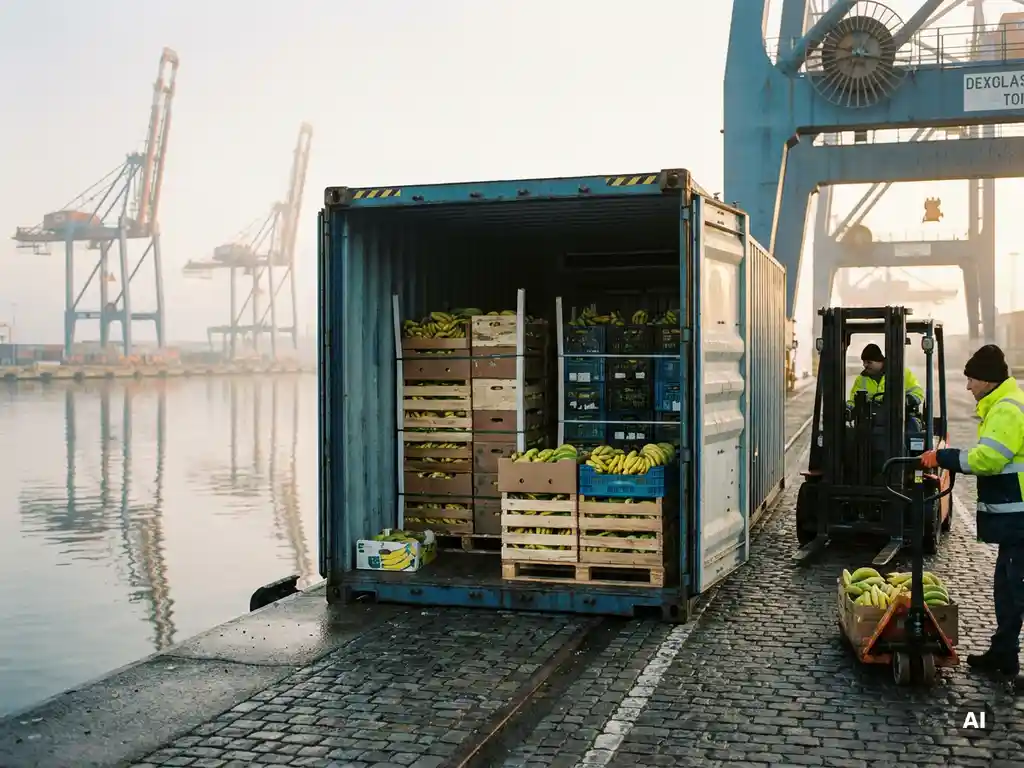
Storage close to a port such as Antwerp or Rotterdam offers logistical, financial, and quality advantages that storage further inland cannot match. For importers and supply chain managers of fresh, perishable products, the distance between ship and cold storage is decisive for both product quality and operational costs. This article answers the most frequently asked questions about port storage, from logistical efficiency to location selection.
What logistical advantages does storage directly on the quay offer?
Storage directly at the quay eliminates the link between unloading and storage. As soon as a ship docks, the goods move almost immediately from the hold to the storage facility, without an intermediate road trip, additional transshipment point, or waiting time at an external terminal. This significantly shortens lead times and reduces the risk of delays in the supply chain.
For time-sensitive cargo, this difference is concretely felt. Every extra link in the logistics chain means an extra moment when something can go wrong: a delayed truck, a full terminal, changing weather during transport. Direct quay connection largely eliminates those risks.
An additional advantage is the flexibility regarding sailing schedules. When a storage location is situated directly on the water, cargo reception can be coordinated with the ship's arrival time, even outside office hours. This makes the entire supply chain more robust and less dependent on external planning factors.
How does port location affect the quality of perishable fruit?
The port location has a direct impact on the quality of perishable fruit, as the time between unloading and cooling determines shelf life and freshness. The shorter this period, the better the quality is preserved. Every minute that fruit stands outside a controlled temperature accelerates ripening and increases the risk of quality loss.
Exotic fruits such as bananas and citrus fruits are particularly sensitive to temperature fluctuations. Bananas ripen quickly at higher temperatures and can suffer irreparable damage if exposed to outdoor temperatures for too long. Citrus fruits are sensitive to moisture loss and can wilt quickly if humidity is not precisely controlled.
A cold storage location directly at the port makes it possible to keep the cold chain virtually uninterrupted. This is not only a quality argument, but also a commercial one: products arriving at the customer in optimal condition mean less waste, fewer complaints, and a more reliable reputation as a supplier.
What are the cost advantages of storage near a seaport?
Storage near a seaport lowers transport costs, reduces the number of transshipment steps, and shortens lead times, resulting in lower operating costs per unit of product. Fewer kilometers, less fuel, and less handling are the three main cost-saving factors.
In concrete terms, port storage means the following for the cost structure:
- Lower transport costs: The distance between the ship and the storage location is minimal, causing drayage costs (local container transport) to decrease significantly or even disappear.
- Reduced handling: Every extra transfer costs money and increases the risk of damage. Direct storage at the quay limits the number of operations.
- Shorter lead time: Faster product availability means that stocks can be delivered sooner, which benefits cash flow.
- Less quality loss: Less waste and fewer complaints translate directly into lower costs further down the chain.
- More efficient customs clearance: Port-related storage locations are often closely linked to customs procedures, which shortens administrative processing time.
On an annual basis, these savings can add up significantly for high-volume importers, especially when it comes to products with a short shelf life where every day counts.
Which products benefit most from port-related cold storage?
Fresh, perishable products with a short shelf life benefit most from port-bound cold storage. The more sensitive a product is to temperature, humidity, and time, the greater the benefit of a short distance between unloading and cooling.
In practice, it mainly concerns:
- Bananas: Very sensitive to temperature fluctuations and ethylene exposure. Immediate cooling after unloading is essential to control ripening.
- Citrus fruits: Oranges, lemons, and grapefruits require precise humidity control to prevent moisture loss and mold formation.
- Tropical fruit: Mangoes, pineapples, and papayas are heat-sensitive and lose quality quickly with insufficient cooling.
- Nuts, peanuts, and seeds: Although not perishable in the same way as fresh fruit, these products are susceptible to moisture and mold formation. Dry storage at the port offers logistical advantages here as well.
The common characteristic of all these products is that the loss of quality is irreversible. One day too hot means a product that no longer meets the customer's specifications.
What is the difference between storage in Antwerp and Rotterdam?
The main difference between storage in Antwerp and Rotterdam lies in the type of supply routes, the hinterland connections, and the specific product flows passing through each port. Both ports are major European hubs, but they serve partly different markets and countries of origin.
Rotterdam as a gateway to Northern Europe
Rotterdam is the largest port in Europe and serves as the primary port of entry for many large-scale product flows towards Northern and Eastern Europe. The port has excellent connections via road, rail, and inland waterways to Germany, Scandinavia, and beyond. For importers wishing to quickly distribute large volumes to multiple European destinations, Rotterdam is often a logical choice.
Antwerp as a hub for Central Europe
Antwerp holds a strong position as a port of entry for Central Europe, particularly for Belgium, France, and the Southern European market. The port accounts for a large share of tropical fruit imports, partly due to historical trade relations with producing countries in Africa and Latin America. For importers targeting these markets, Antwerp offers specific advantages in terms of direct connections and specialized handling.
In practice, the choice between the two ports depends heavily on the origin of the cargo, the final destination of the products, and existing contracts with shipping companies.
How do you choose the right storage location near a port?
You choose the right storage location near a port based on four factors: the connection to the port of arrival for your products, the technical specifications of the storage facility, the certifications of the location, and the flexibility of the service provider with regard to your logistics planning.
Start by asking which port your products enter through. A storage location that does not connect to the supply route always results in extra transport costs and loss of time. Next, check whether the facility has the correct temperature zones and humidity control for your specific product.
Certifications are a reliable indicator of quality and food safety. Look for locations with recognized certifications in the areas of food safety, organic storage, or other relevant standards for your product category. Also inquire about the possibilities for on-site import inspection and customs clearance, as this can significantly shorten lead times.
Finally, flexibility is a distinguishing factor. Sailing schedules are rarely predictable down to the minute. A storage partner that adapts its operation to the ship's arrival time, even outside regular working hours, offers a structural advantage over a location with fixed opening hours.
How ZZColdstores helps with port-related cold storage
ZZColdstores combines its own quay in the Port of Vlissingen with specialized cold and dry storage facilities in Kruiningen and Vlissingen. This makes it possible to organize the entire logistics chain from ship to storage in-house, with minimal intermediate links.
What ZZColdstores specifically offers for importers of fresh fruit and other food products:
- Direct unloading from the ship to the cold storage via a dedicated quay in Vlissingen, ensuring the cold chain remains virtually uninterrupted
- Temperature and humidity control tailored to specific product requirements, monitored 24 hours a day, seven days a week
- Flexible scheduling that aligns with the ship's sailing schedule, even outside office hours
- Dry storage capacity of 12,000 pallet spaces for nuts, peanuts, seeds, and other food products
- Certifications including BRC, SKAL, and Demeter, as a guarantee of quality and food safety
- Support with import inspection via KCB and customs clearance
Would you like to know if ZZColdstores locations align with your supply routes and product requirements? Contact us directly for a no-obligation consultation with our Operations Director, Frans van der Maas.
Frequently Asked Questions
How long can perishable fruit be safely stored in a port-bound cold storage cell?
The maximum storage duration varies by product and depends heavily on the condition upon arrival, the temperature setting, and humidity control. Bananas are typically stored for a few weeks before ripening, while citrus fruits can be kept for several weeks to months under optimal conditions. The key is that the cold chain is closed as early as possible after unloading — any delay before cooling shortens the available storage time at the end of the chain.
What happens if a ship arrives delayed — how flexible is port storage in practice?
Shipping delays are the rule rather than the exception, and a good storage partner takes this into account systematically. Professional port-based storage locations operate based on sailing schedule updates and adjust their operational planning to the actual arrival time, even outside office hours or on weekends. When selecting a storage partner, it is wise to explicitly ask about their policy regarding delays and off-peak delivery, so that there is no ambiguity when it really matters.
As an importer, can I also make use of port storage if I do not ship large volumes?
Yes, port-related storage facilities typically work with flexible storage arrangements that are also suitable for smaller or fluctuating volumes. Instead of purchasing a fixed storage capacity, many providers allow you to work based on the actual pallet spaces or cubic meters used. However, it is advisable to make clear agreements in advance regarding minimum purchases and availability, so that you are certain there is capacity when your shipment arrives.
What minimum certifications should I expect from a reliable cold storage facility at the port?
For food products, BRC (British Retail Consortium) and IFS (International Featured Standards) are the most recognized food safety certifications and are often required by major retailers and buyers. If you import organic products, SKAL certification (Netherlands) or equivalent organic labels are indispensable. Additionally, inquire about specific certifications relevant to your product category, such as Demeter for biodynamic products or KCB accreditation for import inspections of fresh fruit and vegetables.
How does customs clearance work for port-related storage, and can it be done on-site?
At many port-related storage locations, on-site customs clearance is possible, which significantly shortens turnaround time compared to an external customs procedure. Products can be stored in a bonded warehouse while clearance is in progress, ensuring no unnecessary delays occur in the physical chain. When choosing a storage location, verify whether the facility is a recognized bonded warehouse and whether support is provided for submitting the necessary documentation, such as phytosanitary certificates and import permits.
What are the most common mistakes importers make when choosing a storage location?
The most common mistake is choosing a storage location based purely on price, without considering the distance to the port of arrival or the technical suitability of the facility for the specific product. A second common mistake is underestimating the importance of flexibility: a cheap location with fixed opening hours can lead to a loss of quality in the event of a delayed ship that far exceeds the initial cost savings. Also, ensure that you verify the location's certifications before signing the contract, so that you do not face surprises during customer audits afterwards.
Is the port of Vlissingen a realistic alternative to Antwerp or Rotterdam for importers of tropical fruit?
For importers targeting the Benelux and Central European markets, Vlissingen is certainly a serious alternative, particularly due to direct quay access and shorter congestion issues compared to larger ports. Vlissingen has a growing share in the supply of agricultural bulk products and fresh fruit, partly because specialized facilities such as direct cold storage at the quay are available there. Ultimately, the choice depends on the shipping companies you work with and the routes they sail—it is advisable to discuss this specifically with both your shipping company and your storage partner.
Related articles
- What requirements apply to the commercial storage of food products?
- How does packaging quality affect the shelf life of dried fruit?
- How long can you safely store garlic in a temperature-controlled warehouse?
- What is conditioned storage at a temperature of 11°C?
- How do you recognize insect infestation in stored nuts or garlic?