
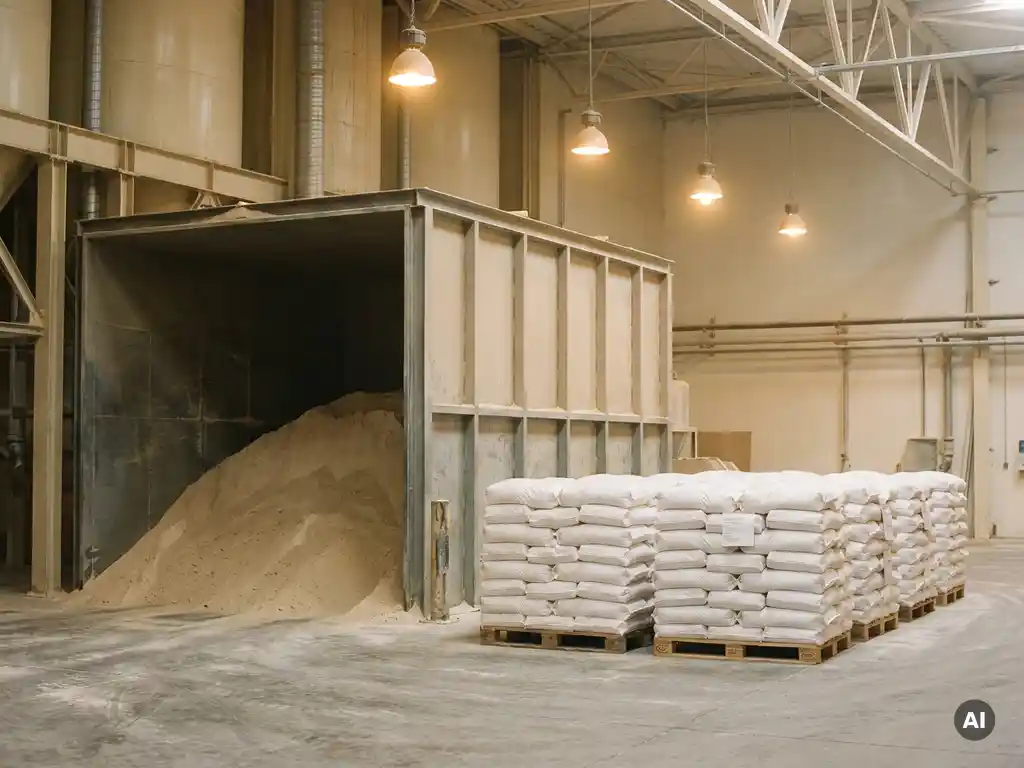
The main difference between bulk and packaged storage of potato powder lies in the way the product is stored and processed: in bulk storage, the powder is stored unpackaged in bulk, whereas packaged storage uses closed units such as bags or big bags on pallets. The choice between the two methods has direct consequences for quality preservation, costs, flexibility, and logistical handling. The questions below will help you make the right decision for your specific situation.
Which storage method preserves the quality of potato powder better?
Packaged storage generally preserves the quality of potato powder better than bulk storage. The packaging forms a physical barrier against moisture, air, and external contamination. In bulk storage, the product is directly exposed to the storage environment, meaning the requirements for that environment are much stricter and the risk of quality loss is greater due to fluctuations in temperature or humidity.
Potato powder is a hygroscopic product: it attracts moisture from the environment. As soon as the moisture content rises, clumping, microbiological growth, and loss of functional properties can occur. In packaged storage, the packaging provides an extra layer of protection that significantly reduces this risk. In bulk storage of potato powder, the storage environment itself is the only barrier, which means that climate control and hygiene of the storage area are absolutely critical.
For producers and traders who wish to store potato powder for longer periods or distribute it to multiple destinations, packaged storage offers greater certainty. Loose storage can be more efficient in specific situations, but requires a tightly controlled environment to provide the same quality guarantee.
What are the logistical advantages and disadvantages of bulk storage?
Bulk storage of potato powder offers higher storage density and lower packaging costs, but places high demands on storage infrastructure and hygiene. The product is typically stored in silos, bunkers, or large containers without individual packaging, which simplifies unit handling but increases vulnerability to environmental influences.
Advantages of bulk storage
- Higher volume utilization per storage space, which can lower the cost per ton
- Less packaging material is needed, which reduces material costs
- Easier to combine with direct production lines or processing plants
- Faster transfer of large volumes, without manual palletizing
Disadvantages of bulk storage
- High investments in specialized infrastructure such as silos and pneumatic transport
- Increased sensitivity to moisture, air, and cross-contamination
- More difficult to trace by batch or lot number without additional systems
- Cleaning and changing products requires more time and care
- Less flexible for small or fluctuating orders
For large-scale processors who incorporate potato powder directly into a production process, bulk storage of potato powder can be the most efficient choice from a logistical perspective. For traders or distributors who want to respond flexibly to fluctuating customers, the disadvantages often outweigh the benefits.
How does packaged storage differ in terms of cost and flexibility?
Packaged storage of potato powder entails higher packaging costs but offers greater flexibility in order sorting, traceability, and distribution. The product can be assigned to specific customers or destinations per pallet or per bag, which significantly simplifies logistics handling for traders serving multiple buyers.
The costs of packaged storage consist of multiple components: the packaging itself, palletizing, storage space per pallet, and any additional handling such as labeling or repalletizing. Although this is more expensive per unit than bulk storage, the costs are more predictable and easier to allocate to specific orders.
Flexibility is a clear advantage of palletized potato powder storage. Individual units can be selected, combined, or forwarded without affecting the rest of the batch. This makes packaged storage particularly suitable for suppliers delivering to supermarket purchasing organizations or processing plants with fluctuating order quantities.
What temperature and humidity requirements apply to potato powder?
Potato powder requires dry storage at a stable temperature of approximately 10 to 15 degrees Celsius and a relative humidity of no more than 65 percent. Fluctuations outside these ranges increase the risk of clumping, microbiological activity, and loss of functional properties such as binding capacity and solubility.
The temperature requirement makes potato powder suitable for so-called ambient storage, also known as dry storage or conditioned storage. This is cooler than a normal warehouse temperature on hot summer days, but warmer than refrigerated storage for fresh products. It is therefore not about active cooling, but about a stable, controlled environment that prevents temperature peaks.
Humidity is at least as important as temperature. Potato powder exposed to high relative humidity absorbs moisture, which directly affects shelf life and processability. Good ventilation and vapor-proof packaging or storage walls are therefore essential, for both bulk and packaged storage.
When do you choose loose bulk and when packaged?
The choice between bulk and packaged storage depends on the volume, destination, and degree of processing. For large, continuous volumes going directly to a production line, bulk storage is logical. For smaller or fluctuating volumes for multiple customers, packaged storage is more practical and easier to manage.
A structured assessment helps with the decision:
- Determine the volume and throughput rate. Large, stable volumes are better suited for bulk storage of potato powder. Small or fluctuating quantities require the flexibility of packaged units.
- Consider the product's destination. Is it going directly to a processing plant with its own silo infrastructure? Then bulk storage is more efficient. Is it going to multiple customers or a distribution network? Then choose pallet storage.
- Weigh the traceability requirements. Customers such as supermarket purchasing organizations are placing increasingly strict demands on lot traceability. Packaged storage makes this easier to achieve.
- Take the storage duration into account. For longer storage periods, packaging offers extra protection against loss of quality, regardless of the quality of the storage environment.
- Analyze the entire logistics chain. Are intermediate steps such as repalletization, labeling, or repackaging required? If so, packaged storage is usually the most practical starting point.
Which certifications are required for the storage of potato powder?
In Europe, mandatory hygiene and food safety requirements apply to the storage of potato powder as a foodstuff, based on European food legislation. In practice, buyers such as supermarket purchasing organizations and processing plants additionally request BRC certification or a comparable GFSI-recognized certificate as a minimum requirement for approved storage partners.
The most relevant certifications for dry storage of potato powder are:
- BRC Global Standard for Storage and Distribution: the most requested certification by European retailers and manufacturers; covers hygiene, traceability, and quality management.
- FSSC 22000 or IFS Logistics: alternatives accepted by certain customers as equivalent to BRC
- HACCP implementation: legally required for every link in the food chain; forms the basis upon which all other certifications build
- SKAL (for organic products): required when the potato powder has an organic status that must be maintained during storage and handling
In addition to certifications, practical aspects also play a role: a demonstrable pesticide policy, written procedures for cleaning and pest control, and a traceable system for lot numbers are standard components of the assessment during audits.
How ZZColdstores helps with the storage of potato powder
ZZColdstores offers dry ambient storage in a stable, controlled environment specifically suitable for shelf-stable food products such as powdered potatoes. The storage facilities in Kruiningen and Vlissingen are designed for products that require a constant temperature and low humidity, without the costs of active cooling.
What ZZColdstores offers for clients in this segment:
- Dry ambient storage at a stable temperature, tailored to the product requirements of potato powder and similar dry food products
- Unloading and loading of containers, for both bulk and palletized shipments, with direct quality control upon arrival
- Repalletization and labeling according to customer specifications, including barcode-driven traceability per lot number
- BRC and SKAL certification, so that clients meet the requirements of European retailers and processing plants
- Shuttle transport between production locations and the warehouse in Kruiningen within a radius of 40 km
Do you want to know which storage method best suits your product and logistics chain? Contact ZZColdstores for a concrete discussion of the possibilities.
Frequently Asked Questions
How long is powdered potato shelf life if stored correctly?
With proper storage — dry, dark, and at a stable temperature of 10 to 15°C with a relative humidity below 65% — potato powder typically has a shelf life of 12 to 24 months. Packaged product retains this shelf life better than loose product, because the packaging forms an additional barrier against moisture and oxidation. Always check the manufacturer's specifications, as the exact shelf life may vary depending on the moisture content during production and the packaging materials used.
What are the most common mistakes when storing potato powder and how do you avoid them?
The most common mistakes are: storage at excessively high humidity, insufficient ventilation in the storage area, and mixing batches with different lot numbers without adequate registration. These errors lead to clumping, loss of quality, and traceability problems that are immediately apparent during audits. Avoid these risks by implementing climate monitoring, never placing packaging directly on the floor (use pallets with sufficient distance from the wall), and using a clear FIFO (first in, first out) system for inventory management.
Can potato powder be stored together with other products, or is separate storage required?
In principle, potato powder can be stored together with other dry food products, provided there is no risk of cross-contamination—either physical or via odors or allergens. Products with a strong odor, such as spices, can affect the taste and smell of potato powder if the packaging is not completely vapor-proof. In the case of combined storage, strict zoning, separate handling, and clear documentation per product category are required to comply with BRC and HACCP requirements.
How do I switch from bulk to packed storage without loss of quality during the transition?
A transition from bulk to packaged storage requires careful planning: ensure that the product is exposed to as little humid air as possible during packaging, preferably work in a climate-controlled room, and use vapor-barrier packaging materials that meet the product requirements. Have the new packaging validated in advance for sealing and moisture barrier, and document the packaging process for traceability purposes. If in doubt, engage a specialized co-packer or logistics service provider with experience in dry food powders.
What information do I need to provide to a storage partner to receive a good quote?
For an accurate quotation, a storage partner requires at least the following information: the expected monthly volume (in tonnes or pallets), the desired storage duration, the type of packaging (big bags, sacks, bulk), any certification requirements from your customers, and whether additional services are needed, such as labeling, repalletization, or transport coordination. The more specific you provide this information, the better the storage partner can assess whether the facility and working methods align with your product requirements and logistics chain.
Is refrigerated storage sometimes necessary for potato powder after all, or is ambient storage always sufficient?
In most cases, conditioned ambient storage is sufficient for potato powder, provided the temperature remains stable and humidity is controlled. Active cooling is generally not necessary and would unnecessarily increase costs. An exception may arise for specific functional potato powders with a high fat content or for products intended for markets with very strict quality requirements; in that case, consult the supplier's or manufacturer's product specifications to determine the exact storage conditions.
How does lot traceability work in practice for the packaged storage of potato powder?
In packaged storage, each lot or batch is identified via a unique lot number linked to the physical units—bags, big bags, or pallets—and registered in a warehouse management system (WMS). Upon receipt, the lot number is scanned and recorded along with production data, supplier information, and the receipt date; upon delivery, the same link is made to the customer order. This makes it possible to quickly determine which units are affected and to which customers they were shipped in the event of a quality incident or recall—a requirement for BRC audits and an expectation of professional purchasing organizations.
Related articles
- How does packaging quality affect the shelf life of dried fruit?
- What is the difference between a bonded warehouse and a regular warehouse?
- What is the difference between floor-loaded and palletized containers?
- How are big bags unloaded and redistributed onto pallets in a warehouse?
- What are the risks of larvae and insects when storing dried fruit?