
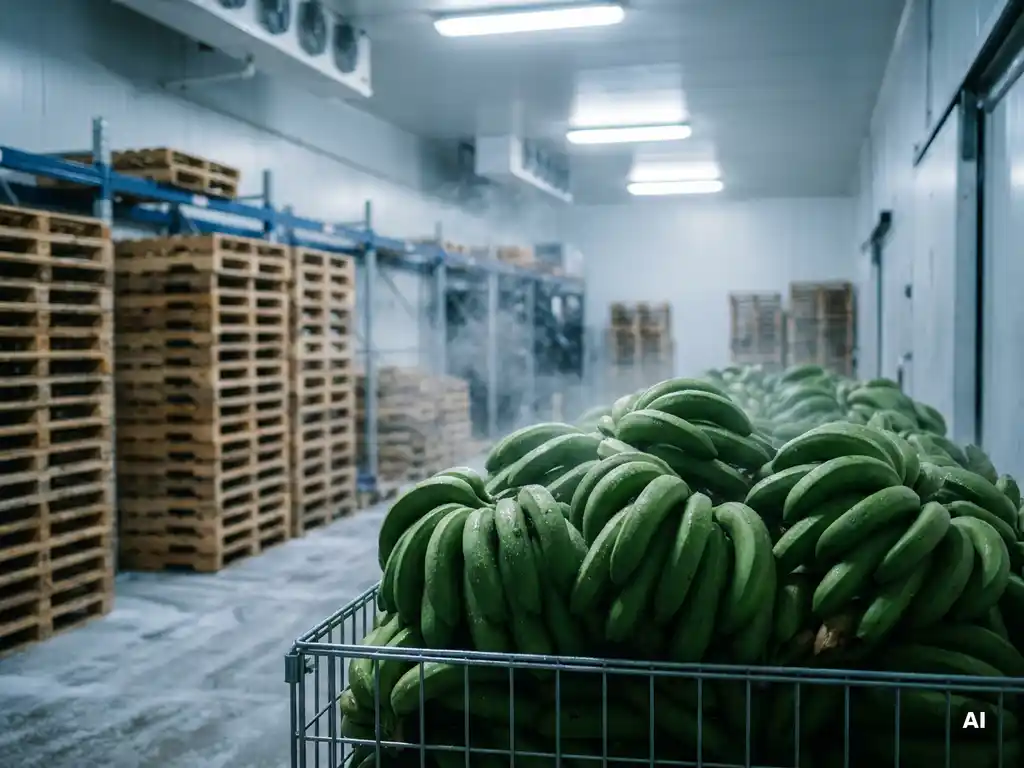
Conditioned storage at 11°C is a form of temperature-controlled preservation in which the storage area is kept at a precise, fixed temperature of 11 degrees Celsius. This method was specifically developed for delicate tropical products such as bananas and citrus fruits, which suffer damage at lower temperatures. The following sections answer the most frequently asked questions about this form of storage.
Which products require storage at exactly 11°C?
Products that require storage at exactly 11°C are primarily tropical and subtropical fruits that are naturally adapted to a warm climate. Bananas are the best-known example: at temperatures below 12°C, they are damaged by the cold, which manifests as brown spots on the peel and a change in taste. Citrus fruits such as limes and certain orange varieties are also sensitive to storage temperatures that are too low.
The reason that exactly 11°C is maintained as the standard is that this temperature strikes a balance between two risks: too warm means the ripening process proceeds too quickly, while too cold causes cold damage (also known as “chilling injury”). For importers and wholesalers sourcing exotic fruit from tropical countries, cold storage for exotic fruit at this precise temperature is therefore not a luxury, but a logistical requirement.
- Bananas (both green and partially ripened)
- Limes and certain orange varieties
- Mangos in specific ripening stages
- Papayas and other cold-sensitive tropical fruits
How does temperature control work in a temperature-controlled cold storage facility?
Temperature control in a conditioned cold storage facility operates via a combination of automated cooling systems, sensors, and air circulation that are continuously monitored. The cooling system maintains the temperature at the desired value, while sensors at multiple points in the cell measure whether deviations occur. In climate-controlled storage, the temperature is monitored 24 hours a day, 7 days a week.
A well-conditioned cold storage facility uses multiple measuring points distributed throughout the storage space so that the temperature remains stable, even in the corners and near the doors. This is important because warm air enters every time a door opens. Modern systems compensate for this automatically. For products that must be stored at 11°C, a deviation of even a few degrees is sufficient to cause a loss of quality.
What is the difference between temperature-controlled storage and conventional cooling?
The difference between conditioned storage and conventional refrigeration lies in the degree of precision and control. Conventional refrigeration simply keeps products cool, usually within a wide temperature range. Conditioned storage, also known as climate-controlled storage or controlled preservation, precisely manages a specific temperature and humidity, tailored to the exact needs of the product.
With standard cooling, a margin of several degrees is acceptable. With conditioned storage at 11°C, the temperature is kept within a range of sometimes less than half a degree. This requires more advanced equipment, better insulation, and an active management system. For products such as bananas, this difference becomes immediately apparent: storage at too low a temperature for just a few hours can already lead to unsaleable batches.
Conventional refrigeration is suitable for products that are less temperature-sensitive, such as certain vegetables or processed foods. Conditioned storage is necessary for delicate exotic fruit, where the temperature control chain must be uninterrupted.
Why is humidity just as important as temperature at 11°C?
Humidity is just as important as temperature during conditioned storage at 11°C, because humidity that is too low causes moisture loss from the product, leading to weight loss, wrinkling, and quality deterioration. Humidity that is too high promotes mold growth and bacterial spoilage. The ideal humidity for most tropical fruits is between 85 and 95 percent.
In an environment that is too dry, bananas rapidly lose moisture from their peel, which shortens their shelf life and impairs their presentation upon delivery. At the same time, condensation on the product is a risk if humidity is too high or if temperature fluctuations occur. Conditioned storage therefore always combines temperature control with active humidity management, which is a significant difference compared to simple cold rooms.
How long does exotic fruit remain good when stored under controlled conditions at 11°C?
With proper conditioned storage at 11°C, exotic fruit such as green-harvested bananas generally remains good for two to four weeks, depending on the stage of ripeness upon arrival and the specific variety. Citrus fruits can be kept for several weeks to months under the right conditions. The exact shelf life varies by product and origin.
Shelf life is determined not only by the storage temperature itself, but also by the quality upon arrival, the speed with which the product is brought into the refrigerated area after unloading, and the consistency of the temperature throughout the entire storage period. Any interruption in the cold chain, no matter how short, affects the final shelf life. Therefore, the transition from transport to storage must take place as quickly as possible.
What role does the location of a cold storage facility play in conditioned storage?
The location of a cold storage facility plays a decisive role in temperature-controlled storage, as the distance between unloading and cooling directly affects product quality. The shorter the time between leaving the ship and entering the climate-controlled space, the better the quality is preserved. A cold storage facility directly on the quay offers a significant advantage in this regard.
Location is also relevant for the subsequent logistics chain: a cold storage facility that is easily accessible by road and situated near major ports shortens lead times and reduces the risk of temperature fluctuations during transport to the next link in the chain. For supply chain managers and importers, the location of a storage site is therefore a serious selection criterion, alongside the technical specifications of the cold storage unit.
When is conditioned storage at 11°C mandatory or necessary?
Conditioned storage at 11°C is required as soon as the product you are storing has a biological minimum storage temperature that exceeds the standard cooling range. For bananas, this is legally enshrined in European standards for the import of fresh fruit: the cold chain must be demonstrably guaranteed. Importers and wholesalers are responsible for demonstrating correct storage conditions.
In addition to legal obligations, the certification of the storage location also plays a role. Certifications such as BRC impose requirements on the traceability of temperature data and the control of storage conditions. For products traded under SKAL or Demeter certification, additional requirements apply to storage conditions. In that case, a cold room at 11 degrees is not a choice but a condition for meeting the certification requirements.
- Check the minimum storage temperature of your product based on origin and variety.
- Verify whether the storage location can demonstrably meet the required temperature margin.
- Ask about the availability of temperature logs for traceability towards your customer or supply chain partner.
- Check whether the location holds relevant certifications that match your product and market.
- Align the logistics planning with a minimum time between unloading and cooling.
How ZZColdstores helps with conditioned storage at 11°C
As a B2B logistics partner, ZZColdstores offers a complete solution for temperature-controlled storage of exotic fruit, with locations in Kruiningen and Vlissingen. From its own quay in Vlissingen, the product moves from the ship to the climate-controlled storage area in minimal time, resulting in immediate quality gains. The cold rooms can be flexibly adjusted to the specific temperature and humidity requirements of your product.
What distinguishes ZZColdstores as a partner for temperature-controlled storage:
- Own quay in Vlissingen for direct, rapid cooling after unloading
- 24/7 monitoring of temperature, humidity, and air circulation
- Certified via BRC, SKAL, and Demeter for demonstrable quality assurance
- Import inspection via KCB (part of the NVWA) and on-site customs clearance
- Flexible climate settings tailored to your specific product and sailing schedule
- Dry storage available for additional product categories such as nuts and seeds
Are you an importer, wholesaler, or supply chain manager working with exotic fruit and looking for a reliable storage partner? Contact ZZColdstores to discuss which storage solution best fits your logistics chain. You can also read more about the options for dry and ambient storage for additional product categories.
Author: Frans van der Maas, Operations Director ZZColdstores
Frequently Asked Questions
What happens if the temperature in the cold room temporarily rises above or falls below 11°C?
Even a brief deviation from the set storage temperature can have noticeable consequences for delicate tropical fruit. In the case of bananas, a temperature drop to below 10°C can cause cold damage within just a few hours, visible as brown discoloration and changes in taste. It is therefore essential that your storage partner has an alarm system that intervenes immediately in the event of deviations, and that temperature logs are available to provide proof of any damage to your customer afterwards.
Can I store different types of exotic fruit at the same time in one cold room at 11°C?
That is possible, but requires careful coordination. Not all tropical fruits have exactly the same optimal storage temperature or humidity requirements, and some products—such as ripening bananas—emit ethylene gas that can accelerate the ripening of neighboring fruits. Discuss with your storage partner which products are compatible for combined storage, and consider separate cells or a physical separation within the storage area to prevent mutual interference.
As an importer, how can I demonstrate that the cold chain is properly guaranteed towards my customers or during an inspection?
The cold chain is demonstrably maintained via temperature logs kept at multiple measuring points in the cold room throughout the entire storage period. A certified storage location — with certifications such as BRC — is required to maintain and make this data available. Proactively ask your storage partner about reporting options and verify whether the logs meet the traceability requirements of your customer, your retail contract, or the NVWA.
What are the most common mistakes during the transition from sea transport to temperature-controlled storage?
The most common mistake is underestimating the time between unloading and cooling: even a waiting time of a few hours on a warm quay can significantly shorten the shelf life of the product. Other common errors include failing to check the core temperature of the product upon arrival and using a storage location not situated directly at the port. Preferably choose a cold storage facility with its own quay and a standardized cooling protocol to minimize these risks.
Is conditioned storage at 11°C also suitable for organically certified fruit?
Yes, but the storage location must itself possess the relevant organic certifications, such as SKAL or Demeter. Organically certified fruit may not be stored in a facility that does not meet these certification requirements, as this jeopardizes the certification status of the product. Always check in advance whether the storage partner is demonstrably certified for the specific labels required for your product and market.
How do I plan the logistics for temperature-controlled storage as efficiently as possible?
Effective planning begins with aligning your ship's arrival schedule with available storage capacity and your cold storage partner's cooling protocol. Ensure the storage location is informed in a timely manner of the expected unloading volume, product type, and ripening stage so that the correct cell temperature and humidity are pre-set. Also, consider on-site customs clearance and import inspection: a partner who handles these processes internally saves significantly on lead time and reduces the risk of uncontrolled temperature interruptions.
What should I ask when selecting a partner for conditioned storage at 11°C?
Ask at least the following questions: What certifications does the location hold (BRC, SKAL, Demeter)? How narrow is the temperature range the cold storage can maintain, and how is this monitored? Is temperature recording available as an exportable report? How quickly can the product be chilled after unloading, and is there a private quay or direct port access? The answers to these questions largely determine whether a storage partner can actually meet the quality and traceability requirements set by your supply chain.
Related articles
- What requirements must professional food storage meet?
- What is the difference between a bonded warehouse and a regular warehouse?
- What is the difference between ambient storage and cold room storage for food?
- Why is Zeeland a logical location for European food storage?
- How are big bags unloaded and redistributed onto pallets in a warehouse?