
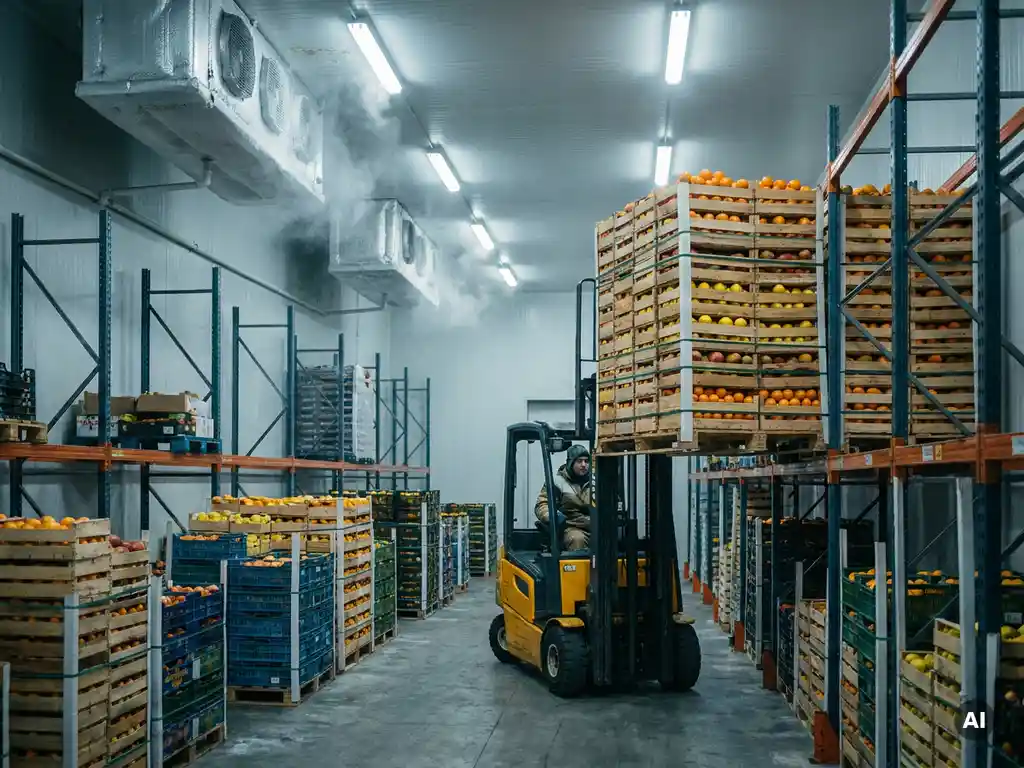
Yes, cold storage is ideally suited for temporary peak stocks. Many logistics and trading companies deliberately use external cooling capacity during seasonal peaks, large supply waves, or periods when their own storage space falls short. In most cases, the minimum storage duration can be set flexibly, meaning you do not enter into long-term commitments. In this article, we answer the most frequently asked questions about the use of cold storage for temporary stocks.
What are the minimum and maximum storage durations for cold storage?
With professional cold storage, there is generally no fixed minimum or maximum storage duration. Most providers work with flexible agreements that align with the customer's actual supply and collection schedule. This makes cold storage particularly suitable for short-term peak stock levels ranging from a few days to several weeks.
For fresh products such as exotic fruit, however, a practical upper limit applies: the shelf life of the product itself determines how long storage is sensible. Bananas can be stored for a few weeks depending on the stage of ripening and the storage temperature, while citrus fruits have a considerably longer shelf life under the right conditions. The maximum storage duration is therefore less of a contractual matter and more of a quality issue.
Short storage periods of one to five days are common during transit from the port to the next link in the chain. Longer periods of two to eight weeks are typical when importers build up stocks for a stable supply to processing plants or supermarket distribution centers.
How does flexible cold storage for peak periods work in practice?
Flexible cold storage for peak periods works in practice by making capacity available on demand, aligned with ship sailing schedules or the customer's supply planning. The cold space is temporarily used for the extra stock, without the customer having to reserve structural storage capacity.
In practice, the process begins with the arrival of a shipment. Upon arrival at the port, containers are unloaded immediately and the goods are transferred to the cold storage area, where temperature and humidity are immediately adjusted to the requirements of the specific product. The shorter the time between unloading and cooling, the better the quality is preserved.
During the storage period, stocks are actively monitored. Quality checks, temperature measurements, and traceability via barcode systems ensure that the batch remains in optimal condition. As soon as the goods are retrieved or forwarded, the space is cleared for the next shipment. This makes the system scalable: during a large influx, occupancy temporarily increases, after which capacity is scaled down again.
Which product types are suitable for temporary cold storage?
Fresh and perishable food products that are sensitive to temperature and humidity are best suited for temporary cold storage. Examples include exotic fruits such as bananas and citrus fruits, but also vegetables and other fresh agricultural products that deteriorate rapidly in quality under improper storage conditions.
Products suitable for temporary cold storage share a number of characteristics:
- They have a limited shelf life that requires precise temperature control
- They are supplied in large volumes, for example by container or by ship
- They must move quickly to the next link in the chain
- They are sensitive to temperature fluctuations during transfer
Products that are less suitable for cold storage are dry, non-perishable goods such as nuts, peanuts, and seeds. These belong in dry storage at a stable ambient temperature, not in a refrigerated environment. It is important to choose the right storage type based on the specific product requirements, not just on the basis of available space.
What is the difference between cold storage and dry storage for peak stocks?
The main difference between cold storage and dry storage is the storage temperature and the type of product for which they are suitable. Cold storage keeps products at a controlled low temperature, typically between 2 and 14 degrees Celsius, depending on the product. Dry storage stores non-perishable products at a stable ambient temperature, such as approximately 11 degrees for nuts and seeds.
Cold storage: for fresh and perishable products
Cold storage is designed for products that spoil quickly without active cooling. In addition to temperature, humidity and air circulation are also continuously regulated. This requires advanced climate control systems and higher operating costs than dry storage. The added value lies in preserving freshness and quality over a longer period.
Dry storage: for stable, non-perishable products
Dry storage is suitable for products that do not require active cooling but do need a stable, controlled environment. Examples include nuts, peanuts, seeds, and dry food ingredients. The storage conditions are less intensive than in cold storage, but the requirements for temperature stability and food safety are no less strict.
For peak stocks, the rule is: choose the storage type based on the product, not on availability. Placing a fresh shipment of citrus fruits in a dry storage area inevitably leads to a loss of quality, and conversely, refrigerated storage of dry products is often unnecessarily expensive.
When is temporary cold storage more cost-effective than your own storage capacity?
Temporary external cold storage is more cost-effective than on-premise storage capacity when storage demand fluctuates significantly and it is not profitable to permanently invest in in-house cooling infrastructure for peak periods. This applies to most importers, wholesalers, and suppliers who depend on seasonal supply.
Owning your own cold storage entails fixed costs: investments in installations, maintenance, energy, personnel, and certifications. These costs continue, even if the space is used intensively for only part of the year. External cold storage makes these costs variable: you pay for what you use, when you use it.
External cold storage is particularly attractive in the following situations:
- Large influx waves from overseas countries of origin temporarily exceeding domestic capacity
- Seasonal peaks where demand for storage varies significantly per quarter
- New product streams for which no dedicated infrastructure is yet available
- When speed of unloading and cooling is crucial and the own location is not directly near the port
Which certifications are relevant when outsourcing cold storage?
When outsourcing cold storage for food products, BRC, SKAL, and KCB/NVWA are the most relevant certifications. These certifications provide assurance regarding food safety, biological integrity, and compliance with import inspection obligations for fresh products.
BRC (British Retail Consortium) is an internationally recognized food safety standard that demonstrates that a storage location meets strict requirements regarding hygiene, temperature control, and traceability. For suppliers to supermarkets, BRC certification is in many cases a strict requirement.
SKAL is the Dutch certification body for organic products. Anyone who stores or processes organically certified products needs a partner who is also SKAL-certified to guarantee the organic status of the products.
The KCB (Quality Control Bureau), part of the NVWA, carries out import inspections for fresh fruit and vegetables entering the EU from third countries. A cold storage facility that works closely with the KCB and Customs can significantly speed up the import procedure, resulting in immediate time savings during temporary peak stocks.
How do you plan the supply and removal of peak stocks at a cold storage facility?
Good planning of inbound and outbound shipments at a cold storage facility begins with sharing the sailing schedule or delivery plan as early as possible. The sooner the cold storage facility knows when a shipment will arrive and its size, the better capacity and staff can be planned. This prevents waiting times and loss of quality due to delays in cooling.
Practical points to consider during planning:
- Coordinate unloading times with the availability of cooling capacity, not just the shipping route
- Please inform us in a timely manner which products will be delivered, including temperature requirements per product type
- Plan the discharge so that products do not remain in refrigeration unnecessarily long and the lead time aligns with customer demand
- Utilize digital systems such as EDI connections for automatic inbound notifications and inventory updates, so that you have real-time insight into the status of your batch
At locations with their own quay, such as in the Port of Vlissingen, the time between unloading from the hold and placement in cold storage is minimal. This is a logistical advantage that directly contributes to better quality preservation during temporary peak stocks, especially for sensitive products such as tropical fruit.
How ZZColdstores helps with temporary cold storage
ZZColdstores offers flexible climate-controlled cold storage in Kruiningen and Vlissingen, specifically designed for fresh and perishable food products. Whether it concerns a one-off peak shipment or a recurring seasonal flow, ZZColdstores adjusts the storage capacity to the actual need.
What ZZColdstores specifically offers for temporary peak stocks:
- Climate-controlled storage with 24/7 monitoring of temperature, humidity, and air circulation
- Own quay in Vlissingen for minimal turnaround time between unloading and cooling
- Quality control upon arrival, including temperature and humidity measurements
- Full traceability via barcode systems, linked to grower and LOT numbers
- Certifications: BRC, SKAL and cooperation with KCB/NVWA for import inspection
- Flexible scheduling tailored to your vessels' sailing schedule
Would you like to know if temporary cold storage at ZZColdstores suits your logistics situation? Contact us and discuss the possibilities with a specialist.
Frequently Asked Questions
How quickly can I activate cold storage in the event of an unexpected peak shipment?
At most professional cold storage facilities, you can bring in extra capacity at short notice, sometimes even within 24 to 48 hours. However, it is wise to build a long-standing relationship with a cold storage partner so that you receive priority during unexpected peaks. Provide the expected arrival date, volume, and temperature requirements as soon as possible so that the cold storage facility can prepare optimally.
What happens if my shipment is delayed and arrives later than planned?
Shipping delays occur regularly, and a good cold storage partner takes this into account. Communicate the delay as early as possible so that reserved capacity and staffing plans can be adjusted. In most cases, the reserved space will be held for you, but it is advisable to make clear agreements regarding this in the contract or cooperation agreement.
How do I know if the quality of my product remains guaranteed during storage?
A reliable cold storage facility offers continuous monitoring of temperature, humidity, and air circulation, combined with quality checks upon arrival and regular interim inspections. When selecting a partner, ask about reporting capabilities: can you, as a customer, gain real-time or daily insight into the storage conditions of your batch? Full traceability via barcode systems and LOT numbers provides extra assurance regarding the status of your product.
Can I combine cold storage with additional logistics services such as sorting, packing, or labeling?
Yes, many cold storage facilities offer additional services alongside pure storage, such as quality sorting, repackaging, labeling, and ripening products like bananas. This is particularly valuable if you send products directly from cold storage to supermarkets or processing plants. Ask in advance which value-added services are available so that you can organize the logistics chain as efficiently as possible.
What are the most common mistakes when outsourcing temporary cold storage?
A common mistake is communicating the arrival and size of a shipment too late, leaving the cold storage facility with insufficient time to plan capacity and staff. Another pitfall is choosing a cold storage partner without the proper certifications for your product type, which poses risks regarding food safety or rejection during import inspections. Finally, companies sometimes underestimate the importance of a location close to the port, whereas every extra kilometer of transport without refrigeration means a loss of quality for sensitive products.
How are the costs of temporary cold storage calculated and what should I look out for?
Costs for temporary cold storage are typically calculated based on the volume occupied (per pallet or m³) per day or per week, supplemented by inbound and outbound costs per movement. When comparing providers, pay attention not only to the storage price per pallet but also to additional costs such as quality control, reporting, and any minimum purchase requirements. A transparent cost structure without hidden surcharges is an important quality characteristic of a reliable partner.
Is temporary cold storage also suitable if I do not yet have a regular import stream but want to test a new product?
Absolutely, temporary cold storage is ideally suited for testing new product flows without having to immediately invest in your own cooling infrastructure. You can start with a limited volume, evaluate logistics and quality preservation, and then decide whether you want to scale up the flow. This makes external cold storage an accessible way to explore new markets or products with minimal financial risk.