
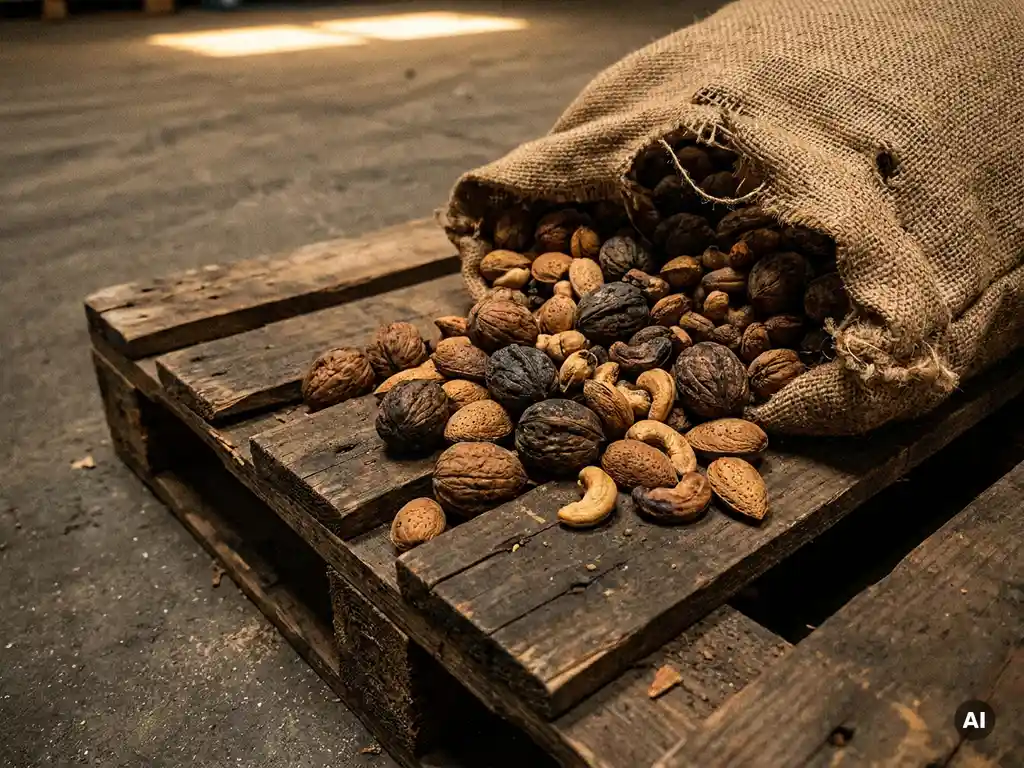
Nuts stored at temperatures too high during transport are damaged by accelerated fat oxidation, mold formation, and moisture imbalance. This leads to rancid-tasting, discolored, or even health-hazardous products that no longer meet the requirements of supermarket purchasing organizations and processing plants. This article answers the most frequently asked questions regarding temperature, identification, and consequences of incorrect storage.
What damage is caused to nuts by heat during transport?
Nuts stored at temperatures too high during transport suffer damage due to two main processes: fat oxidation and mold formation. Fat oxidation occurs as soon as the temperature rises, causing the unsaturated fatty acids in nuts to break down rapidly and the nuts to become rancid. At the same time, heat promotes mold growth, especially when humidity is also not under control.
The damage is not always immediately visible. Internal quality deterioration, such as a bitter or musty taste, can occur without the packaging or the appearance of the nut having changed. This makes nut spoilage during transport particularly difficult to detect without targeted quality control upon arrival.
In addition to organoleptic damage, there is a risk of the formation of mycotoxins, toxic substances produced by certain mold species. This is a serious food safety issue that is strictly limited by European regulations. A batch of nuts exceeding the permitted standards is unsaleable and must be destroyed.
Why are nuts so sensitive to temperature fluctuations?
Nuts are sensitive to temperature fluctuations because they contain a high content of unsaturated fatty acids. These fats oxidize rapidly at higher temperatures, resulting in a loss of quality. Furthermore, moisture penetrates the nut at fluctuating temperatures, which promotes mold growth.
The problem worsens when nuts suddenly move from a cooled room into a warm environment, or vice versa. Condensation on and inside the packaging then poses a direct risk. Water on the nut or in the bag provides mold with exactly the conditions it needs to grow.
Seeds and peanuts share this problem. They also contain fats that are susceptible to oxidation and are vulnerable to humid or warm storage conditions. This makes stable temperature control throughout the entire chain, from origin to storage, a critical factor for the shelf life of these products.
What is the ideal storage temperature for nuts and seeds?
The ideal storage temperature for nuts and seeds is between 10 and 15 degrees Celsius, at a relative humidity of no more than 65 percent. Within this range, fat oxidation is significantly slowed down and mold growth is effectively inhibited. Lower temperatures are beneficial for shelf life but entail higher costs and are generally not necessary for dry, well-packaged products.
For commercial storage in a B2B context, the temperature must be stable, not just low. Fluctuations are more damaging than a constant, slightly higher temperature. A warehouse that stores dry nuts at approximately 11 degrees Celsius therefore offers a good balance between quality preservation and efficiency.
Humidity is at least as important as temperature. A dry storage area with controlled ventilation prevents nuts from absorbing moisture from the environment. This is particularly relevant for products stored in bulk or in large packaging units, where moisture transport between pallets and the outside air can occur.
How do you recognize notes that have been stored incorrectly?
Nuts that have been improperly stored can be recognized by a combination of sensory and visual characteristics. The most common signs are a rancid, bitter, or musty smell and taste, visible mold spots or discoloration, and an altered texture such as softness or stickiness. However, not all damage is visible to the naked eye.
Upon arrival of a shipment, a thorough inspection is essential. Pay attention to the following signs:
- Unusual odor when opening the packaging or container
- Visible mold, spots, or deposits on the nuts themselves
- Discoloration of the nut kernel, from white or cream to yellow or brown
- Condensation on the inside of the packaging
- Damaged or damp cardboard boxes, indicating temperature changes during transport
In addition to visual inspection, moisture measurements and temperature logs are valuable tools. When a container's temperature recording indicates that deviations occurred during transport, further examination of the batch is always justified, even if the nuts appear good at first glance.
What are the consequences of damaged nuts for importers and wholesalers?
For importers and wholesalers, a batch of damaged nuts leads to direct financial loss, reputational risks, and potential legal consequences. Products that do not meet the quality standards of supermarket purchasing organizations or processing plants are refused, returned, or destroyed, with all the associated costs.
The consequences for the supply chain are significant. A rejected batch disrupts the buyer's planning, leading to fines or breach of contract. Importers who consistently deliver quality problems risk losing long-term contracts. Moreover, in the European market, where strict standards apply to mycotoxins and food safety, a batch falling outside the standards cannot be redistributed.
The financial impact consists of multiple layers:
- Loss of the value of the lot itself
- Costs for return logistics or destruction
- Damage claims from customers regarding contractual agreements on quality
- Reputational damage among existing and potential customers
- Possible fines for non-compliance with European food safety standards
Prevention is therefore always cheaper than repair. Investing in good storage conditions and reliable quality control upon arrival is a direct protection of margins and market position for importers and wholesalers.
How does controlled dry storage prevent quality loss in nuts?
Controlled dry storage, also known as ambient storage, prevents quality loss in nuts by maintaining a stable temperature and humidity throughout the entire storage period. Without temperature fluctuations, the oxidation process largely stops, and without excess moisture, mold has no chance to grow. This is the most effective way to extend the shelf life of nuts, peanuts, and seeds.
Well-designed dry storage for nuts combines a stable climate with a clean, controlled environment. Products are stored separately from other goods, ventilation is deliberately managed, and pallets are positioned to allow air circulation around the products. These are not luxury measures, but basic requirements for maintaining quality in sensitive dry products.
Quality control upon arrival is a supplement to proper storage, not a replacement. By immediately measuring temperature and humidity upon inbound, and by immediately separating damaged or defective products from the batch, the spread of a problem to the rest of the shipment is prevented.
How ZZColdstores helps with the storage of nuts and seeds
ZZColdstores offers ambient warehousing specifically designed for dry and non-perishable food products such as nuts, peanuts, seeds, and flakes. The storage facilities in Kruiningen are designed for a stable, dry storage environment at approximately 11 degrees Celsius, without unnecessary cooling capacity. This offers importers and wholesalers a cost-effective solution that actively prevents loss of quality.
What ZZColdstores offers for dry products:
- Ambient storage in a stable, dry environment at the correct temperature
- Quality control upon arrival, including temperature and humidity measurements
- Immediate separation of defective products to protect the rest of the batch
- Barcode-driven traceability per pallet linked to grower and LOT numbers
- Flexible storage capacity of up to 12,000 pallet spaces
- Shuttle transport between production locations and the warehouse (radius up to 40 km)
Would you like to know more about how ZZColdstores properly stores and safeguards your batch of nuts or seeds? Contact us for a no-obligation discussion about the possibilities.
Frequently Asked Questions
How quickly can quality loss occur if nuts are exposed to excessively high temperatures during transport?
Loss of quality can begin after just a few hours of exposure to temperatures above 20 degrees Celsius, depending on the type of nut and the packaging. Walnuts and pine nuts are particularly vulnerable due to their high content of polyunsaturated fatty acids and can develop noticeable rancidity within one to two days. For almonds and cashews, the process is slightly slower, but here too, an uninterrupted cold chain is essential to maintain the desired shelf life.
What mistakes do importers make most often when storing nuts?
One of the most common mistakes is storing nuts in a room that, although cool, has a temperature that fluctuates significantly, for example due to frequent opening of doors or insufficient insulation. Another common mistake is placing pallets directly against walls or without sufficient spacing, which impedes air circulation and causes localized moisture buildup. Finally, quality control upon arrival is frequently skipped, resulting in damaged products being stored unnoticed and potentially contaminating the rest of the batch.
Can I still use nuts that smell slightly rancid for processing or sale?
No, nuts with a rancid odor are no longer suitable for sale or processing, even if the taste deviation is assessed as 'mild'. Rancidity is a sign of advanced fat oxidation, a chemical process that is irreversible and continues even after recooling. Furthermore, processing plants and supermarket purchasing organizations generally do not accept products with any deviation in odor or taste, due to both quality requirements and liability risks.
How do I know if my current storage location is suitable for storing nuts and seeds?
Check at least three things: the average and peak temperature in the storage area over an extended period, the relative humidity and the ability to maintain it stably, and whether there is sufficient ventilation and separation from other product categories. A suitable location for nuts maintains a stable temperature between 10 and 15 degrees Celsius and a relative humidity below 65 percent. If your current location does not meet these requirements, outsourcing to a specialized ambient warehouse is a cost-effective and low-risk solution.
What exactly are mycotoxins, and what European standards apply to them in nuts?
Mycotoxins are toxic compounds produced by mold species such as Aspergillus and Penicillium, which can develop on poorly stored nuts. The most relevant mycotoxins for nuts are aflatoxins, for which the European Union applies strict maximum limits: for aflatoxin B1, a limit of 8 µg/kg applies, and for the total sum of aflatoxins, a limit of 10 µg/kg in nuts intended for human consumption. Batches exceeding these standards may not be placed on the market and must be destroyed, resulting in direct and significant financial damage to the importer.
Is refrigerated storage always better than dry ambient storage for nuts?
Not necessarily. For most dry nuts and seeds, well-controlled ambient storage between 10 and 15 degrees Celsius offers an excellent alternative to expensive refrigerated storage, provided that humidity and temperature stability are ensured. Refrigerated storage below 5 degrees Celsius is particularly relevant for nuts with a very high fat content or for long-term storage of more than six months. Furthermore, the advantage of ambient storage is that the risk of condensation forming upon unloading, a common problem with refrigerated products, is significantly reduced.
How can I, as an importer, demonstrate that quality problems arose during transport and not during storage at my premises?
The key lies in documentation: upon arrival, always ensure a detailed inbound inspection report is available including temperature measurements, moisture values, and visual findings, and link this to the temperature logs of the container or transport vehicle. When the container's temperature recording shows deviations during transport, this constitutes strong evidence that the damage did not occur in your storage facility. Additionally, barcode-driven traceability systems, such as those used by specialized warehouses, provide insight into the complete storage history per pallet, which can serve as irrefutable evidence in claims against carriers or suppliers.